A Vision for Global Community
In a nutshell
Living Well for the Common Good is an open, science-based way of living that anyone can take up, whatever their religion or philosophy. It rests on four pillars:
• Inner cultivation: daily meditation and mindfulness that train the mind toward clarity, contentment, kindness and wisdom.
• Care for the living world: recognizing our interdependence with all life, protecting biodiversity, and regenerating the places we live.
• A gentle and resolute ethic: kindness, generosity and honesty toward all, joined with firm resistance to tyranny, aggression, crime and corruption.
• Local community: small, self-governing circles that practice together, celebrate the seasons, make art and support one another.
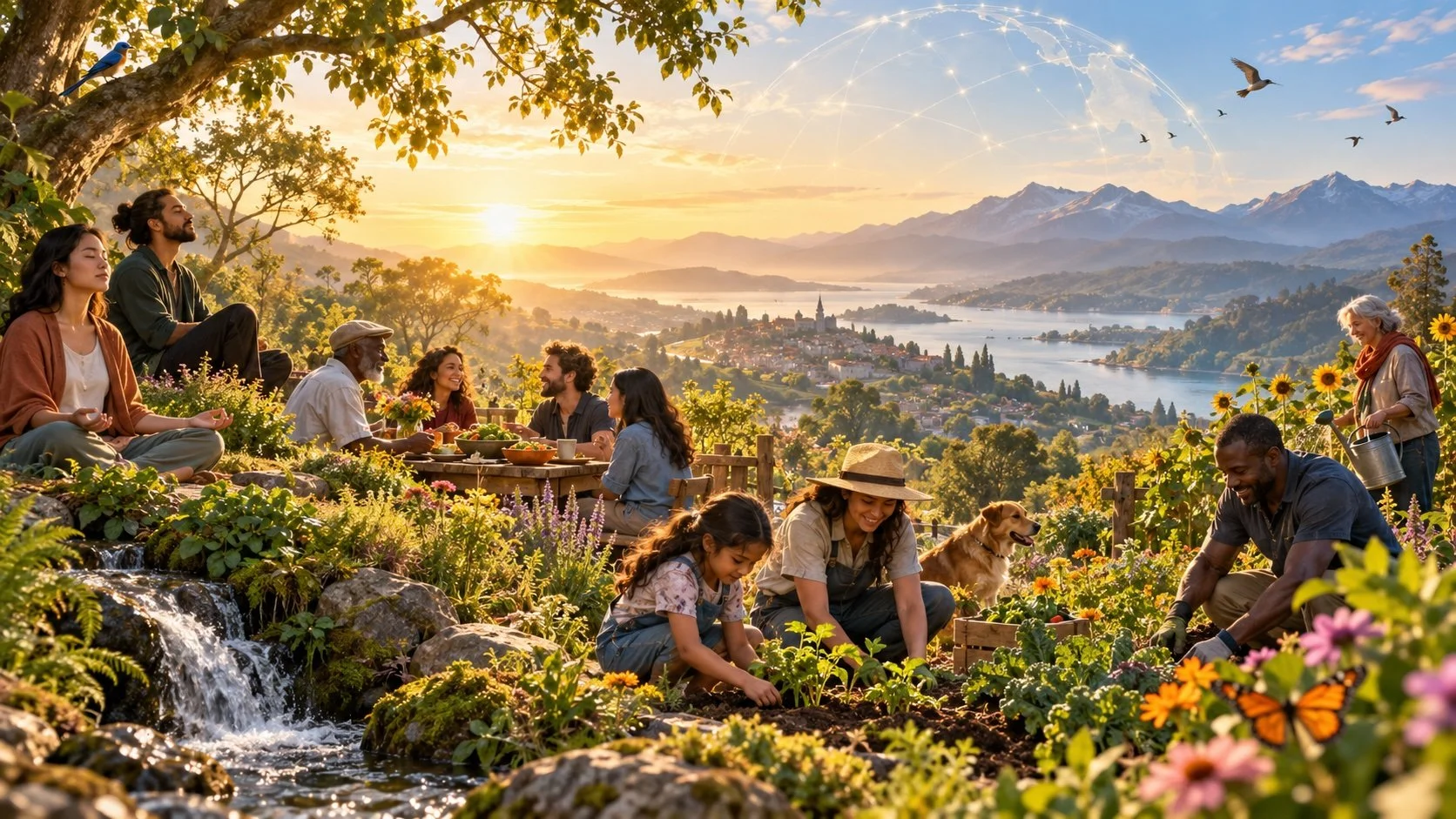
It is designed to be replicated anywhere in the world. Two or three people can start a circle; there is no headquarters, no clergy and no fee. Each circle adapts the practices and festivals to its own culture, language, climate and land, and circles connect locally, regionally and internationally through elected, term-limited representatives.
Inspirations
“I live badly because people, we, live badly. If I live well, I would improve the life of all people everywhere. If we all adopted this view, life of everyone would improve.”
Leo Tolstoy wrote this entry in his diary on November 8, 1910, less than two weeks before his death. I first read this quote in the late '70s, and it is one of those quotes that, once read, permanently changed my view of the world and how best to live in it.
Another such quote is from the widely acclaimed translation by Richard Wilhelm of Hexagram 43 of the Yi-Jing, the Chinese Book of Changes:
“The best way to fight evil is to make energetic progress in the good.”
From the Buddha in the Dhammapada:
“Hatred is never appeased by hatred in this world. By love alone it is vanquished. This is an eternal law.”
And from both the Old and New Testament of the Bible:
“Love your neighbor as yourself.”
Or this quote from Albert Einstein dated February 12, 1950:
“Ein Mensch ist ein räumlich und zeitlich beschränktes Stück des Ganzen, was wir „Universum“ nennen. Er erlebt sich und sein Fühlen als abgetrennt gegenüber dem Rest, eine optische Täuschung seines Bewusstseins. Das Streben nach Befreiung von dieser Fesselung [or Täuschung] ist der einzige Gegenstand wirklicher Religion. Nicht das Nähren der Illusion sondern nur ihre Überwindung gibt uns das erreichbare Maß inneren Friedens.
A human being is a spatially and temporally limited part of the whole that we call the “universe.” They perceive themselves and their feelings as separate from the rest—an optical illusion of their consciousness. Striving to be liberated from this confinement [or illusion] is the sole subject of true religion. It is not the nurturing of this illusion, but rather its overcoming, that grants us the attainable measure of inner peace.”
Such seminal aphorisms can bring great clarity regarding how best to live and have led me to write the following vision of Living Well for the Common Good.
How this began
I began with a simple question: drawing on what we now know from psychology, history, the world's spiritual traditions, philosophy, ecology and politics, how can we live together in a way that brings genuine fulfillment? What I am reaching for was not inventing a new faith or political theory, but a way of living: grounded in scientific evidence, free of dogma, and open to people of every tradition or philosophical background to adopt or reject as they deem appropriate.
Many people have left organized religion and, with it, lost community, enriching ritual and a shared sense of meaning. At the same time, the living world is being degraded and social isolation and loneliness is widespread. Threats to democracy are rising as people are misled by biased news and social media and look to demagogues for solutions, which leads to tyranny and oppression.
My personal path has led me to find universal, self-validating practices that cultivate the heart and mind toward peace, kindness, clarity, insight and wisdom. It has led me to a way of living rooted in care for the earth and fostering local community, helping people flourish while regenerating a damaged ecosystem.
What follows is a work in progress, not a finished credo. Some sections are still being written, and every part is open to question and revision. I share it to start a conversation, and welcome your thoughts, criticisms and ideas.
The premise
We are one living process becoming aware of itself, and we choose to live as if that were true, because both empirical and scientific evidence leans in that direction.
Every atom in our bodies was forged in a star. Every breath we take was exhaled by a forest. Every cell carries a four-billion-year lineage shared with the oak, the salmon and the bee. Science has not taken the wonder out of the world. It has handed us a creation story more astonishing than any we invented, and this one has the advantage of being verifiably true.
This is a way of living, not a religion. It asks for no belief in the unseen and no obedience to anyone. It recommends cultivation: to enable the mind to experience its essential nature, fostering clarity and kindness, to live as a good member of the community of life, and to stand together for a world worth leaving to our descendants.
Its promise is simple. Live this way, and you will likely be calmer, kinder, more connected, happier and more purposeful. Live it together, and the places we live will grow richer in life, not poorer. Make it available world-wide and bring about an era of peace and prosperity.
Because this is not a religion, no conversion is necessary. A Christian, a Buddhist, a Muslim, a Hindu, a pagan or an atheist can practice this way of living and keep their own tradition if they find it helpful. This is a shared practice and ethic, not a rival faith but an understanding; it asks only that each of us keeps growing, and keeps testing what we believe to free ourselves from the self-deception to which we otherwise fall victim.
Foundations
Five principles hold everything else up. None requires faith; each can be tested in your own life.
1. Interbeing. Nothing exists on its own. We are made of sun, soil, rain, ancestors neighbors and descendants. Ecology, physics and biology all point to this, and contemplative practice enables us to experience this unity directly. Harm to the web of life is harm to ourselves.
2. Evidence over authority. We trust what can be experienced directly and, wherever possible, measured. Members may hold any private beliefs, but are asked to keep testing them against experience and evidence; that testing is itself part of waking up. No text, teacher or founder is beyond question. When the evidence changes, we are open to incorporate new understanding.
3. Life is to be affirmed. This world is not just a waiting room for another. Joy, beauty, the body, the senses and ordinary pleasures are part of the path, not distractions from it.
4. The mind can be cultivated. Contentment, compassion and insight are the natural outcome of effective meditative and spiritual practice, not accidents of temperament. Like any skill, they deepen with practice.
5. Mystery is honored, not filled in. Some questions — why there is anything at all, what consciousness ultimately is — remain open. We meet the great mystery with awe and inquiry, never with invented certainty.
The practices
Cultivation comes first; everything else grows from it. It needs no building, equipment or permission, so it can be done anywhere — a city apartment, a prison cell, a farm, a ship.
Daily
• Meditation. Aspire to twenty or thirty minutes of daily meditation, such as settling awareness on the breath, then allowing it to open to whatever arises with clarity. The aim is to let go, be in the present, settle into bright, open, clear awareness and ease of body and mind, not escape. In activity, we face our problems without fear and with insight.
• Good-will practice. End meditation with a few minutes wishing well to yourself, loved ones, strangers, difficult people and all living beings. Research links this practice to greater compassion and resilience.
• Mindful moments. Pausing before eating to remember the soil, rain and hands that grew the food and made the meal; walking with full awareness; listening fully to each person.
• Creating. A little time each day to create something with your hands or voice: a song, a drawing, a poem, a meal made with care, a garden bed. Creativity as an expression of love and a celebration of life.
• Reflection. What did I do well today? Where did I cause harm? What will I repair?
Weekly
• A day of rest. One day apart from commerce, work and screens, given to people, nature, play and silence.
• Time on the land. Hands in soil, feet on a trail, attention on the living place where you are.
• Gathering. Meeting your local circle to sit, share a meal, learn and serve together.
Yearly
• Retreat. Several days of silence and deep practice.
• Fasting and simplicity. A period of voluntary simplicity, to remember what is enough.
• Pilgrimage. A journey on foot to a place of natural or human significance.
The ethic: gentle and unbreakable
We aim to join two qualities that often drift apart: a soft heart and a strong spine. Kindness without courage becomes complicity. Courage without kindness can become cruelty.
Toward all beings
• Do no unnecessary harm — to people, animals, plants or the places that sustain them.
• Speak truthfully and kindly. Truth that wounds for no purpose is not honesty; kindness built on lies is not kindness.
• Give generously of time, skill and resources, especially to those with least.
• Repair harm you cause, openly and without excuses.
• Extend the circle of concern outward: from family to stranger, from our species to all species, from this generation to the seventh one after us.
Against domination
• Stand against tyranny. Defend free speech, fair elections, independent courts and the dignity of every person. Refuse to cooperate with injustice and help others refuse.
• Stand against aggression. Support the right of people and nations to defend themselves from attack. Nonviolence is the first choice, the strongest weapon and the default. We are not aggressors, but we also don't allow the innocent harmed.
• Stand against crime and corruption. Support fair, accountable justice. Protect the vulnerable. Report abuse. Do not look away.
• Never hate. Oppose actions and systems firmly, while remembering the opponent is also a living being who might change. Seek justice, not revenge.
• Elect representatives with integrity. Support representatives that embody our values.
We honor the conscientious objector and the defender alike. Each member discerns their own path in difficult moments; our community supports them in that discernment. These principles, like everything here, are revisited as experience teaches us.
Taking sides. We are not partisan by default. But when an individual, party or movement threatens democracy, human rights or the rule of law, the network of communities may openly oppose it and support those who resist. Such a stand is decided through the councils described below and reviewed regularly.
Ecology and livelihood
We measure our success by whether the places we live grow richer in life. A household, business or town living this way should leave its soil deeper, its water cleaner and its species more numerous than it found them.
Caring for the living world
• Know your place: the watershed you drink from, the native plants and animals around you, the soils and seasons.
• Restore something. Every community circle adopts a patch of land, creek, roadside or rooftop and returns it to life.
• Protect biodiversity as sacred. Each species is a unique expression of four billion years of evolution, and its loss is permanent.
• Eat with care: more plants, local and seasonal food, little waste, and respect for the animals we depend on.
Right livelihood and shared prosperity
• Earn a living that does good and does not harm and help others find such work.
• Seek enough, then share the rest. Beyond a sufficient life, more consumption adds little happiness; relationships, quality time together and sharing add much.
• Build local resilience: gardens, skill-sharing, tool libraries, cooperative or employee-owned businesses and mutual aid.
• Support enterprise and innovation that regenerate: clean energy, restorative farming, durable goods and repair.
• Invest in what you believe in and withdraw support from what harms.
Peace, prosperity and a healthy environment are not separate goals. Degraded land breeds poverty; poverty breeds conflict; conflict degrades land. We work to turn that cycle around.
Community: a network of circles
There is no headquarters, no clergy and no one who rules over others. We are a living network of small local circles, connected like a mycelium beneath a forest.
• Circles stay small. A circle is 8 to 50 people who know each other by name. When one grows larger, it divides, like a cell. Members can visit other circles freely.
• Facilitation rotates. Anyone may lead a sitting, a shared, meaningful ritual or a meeting. No role is permanent, and no one is paid to hold spiritual authority.
• Decisions are made together, by consent: a proposal passes when no one has a serious, reasoned objection.
• Circles federate. Neighboring circles gather for festivals and share resources. Each circle sends a rotating representative to a regional council; regional councils elect representatives to wider councils, up to a global assembly. Councils coordinate and serve, cannot dictate a circle's practice, and their members serve limited terms.
• Teachers are welcome, gurus are not. Experienced practitioners may teach, but they hold no special status, and their conduct is open to the circle's review.
• Anyone may begin. Two or three people practicing together form a circle. Someone alone can practice alone and still belong.
• Safeguards against capture. Finances are open to all members. Leaders who seek power or wealth through their role are asked to step back. Abuse is reported to outside authorities, never handled quietly.
Belonging is voluntary and leaving is free. No one is shunned, and anyone may return.
Creating a culture that reflects our values
Each community can develop its own unique celebrations as they see fit. Here are some that I find attractive.
Seasonal celebrations
The year turns through eight festivals, anchored to the sun and to the local land. Each circle adapts them to its own climate: first rains in one place, first snow in another, monsoon or dry season elsewhere. In the Southern Hemisphere, the calendar flips.
Return of Light (winter solstice, around December 21) honors darkness and renewal. We keep an all-night vigil by candlelight and give gifts to those in need.
Quickening (early February) honors life stirring beneath the ground. We bless the seeds we will plant and set our intentions for the year.
Balance of Spring (spring equinox, around March 20) honors equal day and night and the return of growth. We plant together, restore land, and welcome the children born since last spring.
Blossoming (early May) celebrates fertility, love and abundance with a flower festival, music and dance. It is a favorite time for weddings.
Fullness of Light (summer solstice, around June 21) honors the sun at its height. We gather at sunrise, share an outdoor feast and celebrate our elders.
First Fruits (early August) marks the first harvest. We bake bread together and give thanks to farmers and pollinators.
Balance of Autumn (autumn equinox, around September 22) honors the harvest and the sharing of it. Our harvest feast is open to all, especially strangers.
Remembrance (early November) honors our ancestors and the dead. We remember those who have died, the species we have lost, and the descendants yet to come.
Art brings the festivals to life. Each festival is made, not just attended. Members compose and play music, sing, dance, write poetry, tell stories, stage plays about the land and its creatures, paint, build altars and sculptures from natural materials, and cook. Art expresses what practice reveals but plain words cannot, and shared music and dance are linked in research to social bonding and well-being. Every circle welcomes makers at every level of skill; the point is participation, not performance. Works made for a festival may be given away, left to weather, or returned to the earth, as reminders that all things pass.
Every month: the new and full moons are natural times to gather, sit and share a meal.
Rites of passage mark the great turns of a life: welcoming a newborn, coming of age, committing to a partner, entering elderhood, and dying well. How a body is returned to the earth — natural burial, cremation, human composting or another path — is each person's own choice. Whatever the form, the circle marks the passing as a return to the web of life.
The interbeing practice threads through every rite: pausing to name what the moment is made of — sun, rain, soil, ancestors, strangers, other species — until the sense of a separate self softens into belonging.
What we inherit, and what we leave behind
This way of living belongs to no tradition and is grateful to all of them. We take what has proven to lead to peace, wisdom and flourishing, and we credit its sources honestly.
From the Buddhist traditions we carry forward meditation and mindfulness, the practice of compassion, the insight that clinging causes suffering, and the understanding of interbeing. From the Hindu and yogic traditions, the training of body and breath, the recognition of a shared consciousness behind diverse forms, and nonviolence (ahimsa). From the Daoist traditions, harmony with natural rhythms, simplicity, effortless action and humility before mystery. From the Confucian traditions, ritual as the glue of community, the cultivation of character, and duty across generations.
From the Jewish traditions we take the sabbath, the duty to repair the world, and sacred argument and questioning. From the Christian traditions, love of neighbor and enemy, care for the poor, and the dignity of every person. From the Islamic traditions, a daily rhythm of practice, charity as an obligation, and stewardship of the earth. From Indigenous traditions worldwide, kinship with the land and other species, thinking seven generations ahead, and ceremony tied to place.
And from science and the Enlightenment, we carry forward reliance on evidence, the habit of self-correction, universal human rights, and the evolutionary story of life.
What we leave behind: claims that cannot be tested yet must be believed; chosen peoples and condemned outsiders; hierarchies of spiritual authority; fear of punishment as motive; control of sexuality, dress or thought; contempt for the body and the earth; and any teaching that justifies cruelty.
We approach Indigenous and living traditions with special care: learning with permission, not taking without it.
The commitments
Anyone may take up the practices. Those who wish to belong fully speak these commitments aloud before their circle and renew them each year at the Return of Light.
1. I will practice daily, training my mind toward clarity, contentment and kindness.
2. I will remember that I am part of the web of life, and act to protect and restore it.
3. I will seek truth through evidence and inquiry and hold my views with humility.
4. I will be generous, honest and kind, and repair the harm I cause.
5. I will stand firmly against cruelty, tyranny and injustice, without hatred.
6. I will live simply enough that others, human and not, may simply live.
7. I will support my circle and let it support me.
The commitments are aspirations, not tests. Everyone falls short. What matters is returning to them repeatedly.
Decisions and open questions
The main design tensions are now settled; a few new questions follow from those choices.
Decided
• Universal appeal vs. depth: No one converts; members keep any religion or none. Depth comes through practice.
• Commitment vs. freedom: The eight commitments stand as drafted.
• Science vs. spirit: Direct experience and measurement come first. Private beliefs are welcome and continually tested by the individuals that hold these beliefs.
• Gentleness vs. resistance: The principles are stated; each member discerns; all is revisited as we learn.
• Structure: Local circles federate through elected, term-limited representatives.
• Politics: The network may openly oppose a tyrannical individual, party or movement.
Still open
☐ Criteria for taking sides. What specific signs trigger a network-wide stand (attacks on elections, courts or the press; political violence), and what council vote is required? Clear criteria keep the stand from splitting the network or sliding into ordinary party loyalty.
☐ Councils without capture. Beyond term limits and open finances: recall, and limits on how long anyone serves at any level.
☐ Human development. Rework a section on growing up, waking up and cleaning up (facing the shadow), presented so it invites growth rather than ranking people.
☐ Name, symbol and story. What are ours?
© 2026 Barry Wadsworth. Licensed under Creative Commons Attribution-ShareAlike 4.0 (CC BY-SA 4.0). You may share and adapt this work, provided you credit the author and release your versions under the same license.